Polymath Corporation
BLOCKCHAIN / SYSTEMS

Meridian Protocol

Cross-chain, reputation-based lending protocol.

Protocol development as principal developer. Interface screenshots are from the protocol's own site; contracts and deployments are not published here.

Status
Working prototype
Role
Principal developer — protocol architecture, reputation model, cross-chain integration and application layer.
Categories
BlockchainDeFiCross-ChainSmart ContractsLending
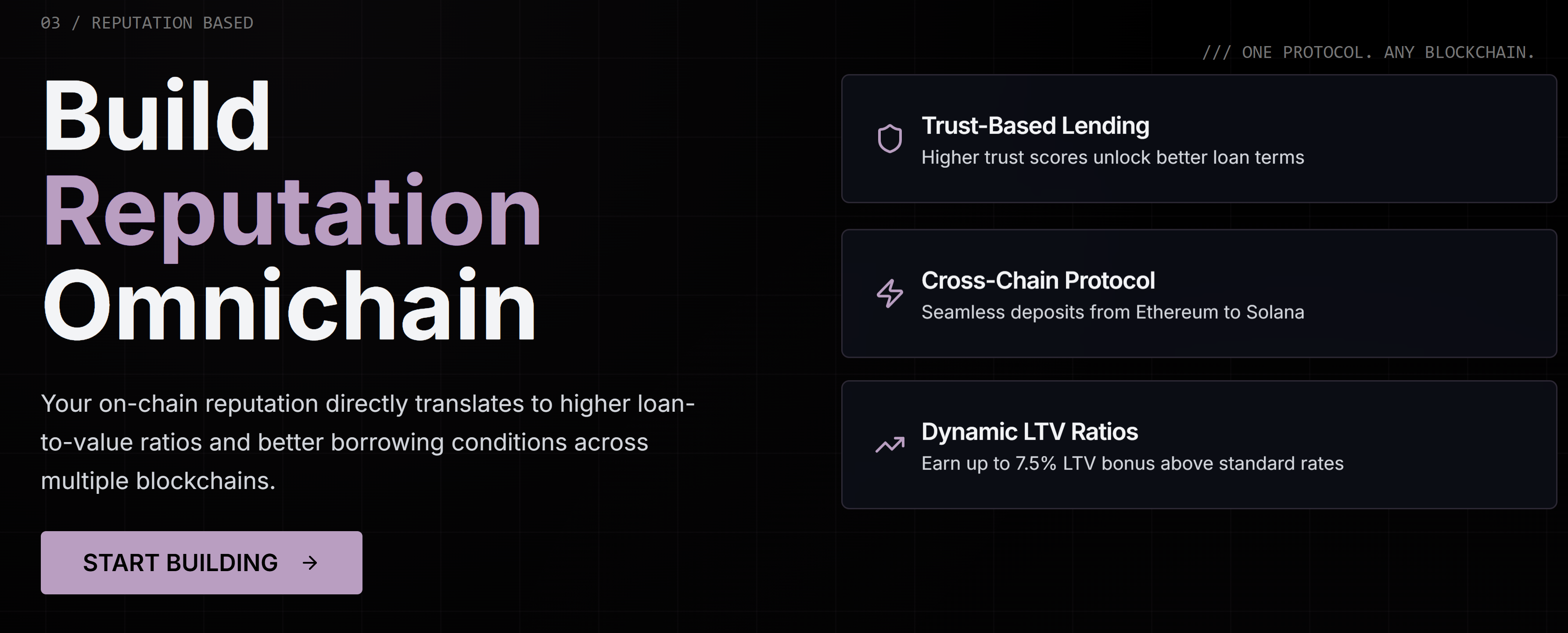
Meridian Protocol landing page showing trust-based lending, cross-chain deposits and dynamic LTV feature cards

01

The problem

Lending protocols price risk with collateral and almost nothing else. A borrower with years of clean on-chain history gets the same terms as a wallet created yesterday — and any reputation that does exist is trapped on the chain it was built on.

Cross-chain makes it worse. Moving value between Ethereum and Solana means bridging, wrapping and state split across two networks, so a protocol lending on both has to reason about identity on one chain and execution on another.

The consequence is that creditworthiness does not travel. Every new chain a protocol touches resets a borrower to zero, and the protocol re-learns the same expensive lesson about the same user.

02

Context

Built to answer one specific question: can on-chain history be turned into borrowing terms meaningfully better than a flat, collateral-only rate — and can that reputation follow the borrower across chains?

Screenshots on this page are from the protocol's own interface. Contract addresses, deployments and live figures are not disclosed.

03

My role

  • Architected the protocol end to end: identity and reputation on Ethereum, lending execution on Solana, and the messaging layer that carries state between them.
  • Designed the reputation model that maps on-chain behaviour to loan terms — a trust score that determines both eligible amount and loan-to-value ratio.
  • Implemented the cross-chain message flow through LayerZero so a position opened against Ethereum history can be acted on on Solana without a custodial step.
  • Built the application layer: the protocol site, deposit and position flows, and the terms surface shown in the screenshots.

04

The solution

Identity and reputation live on Ethereum, where history is longest and most expensive to fabricate. A borrower carries a trust score derived from on-chain behaviour instead of an off-chain credit file.

Lending executes on Solana for cost and throughput, with LayerZero carrying position and reputation state across the two chains.

Reputation is priced rather than displayed. Higher trust scores unlock better loan terms and higher eligible amounts, with dynamic loan-to-value ratios — the interface states up to a 7.5% LTV bonus above standard rates for the strongest scores.

05

Artifacts

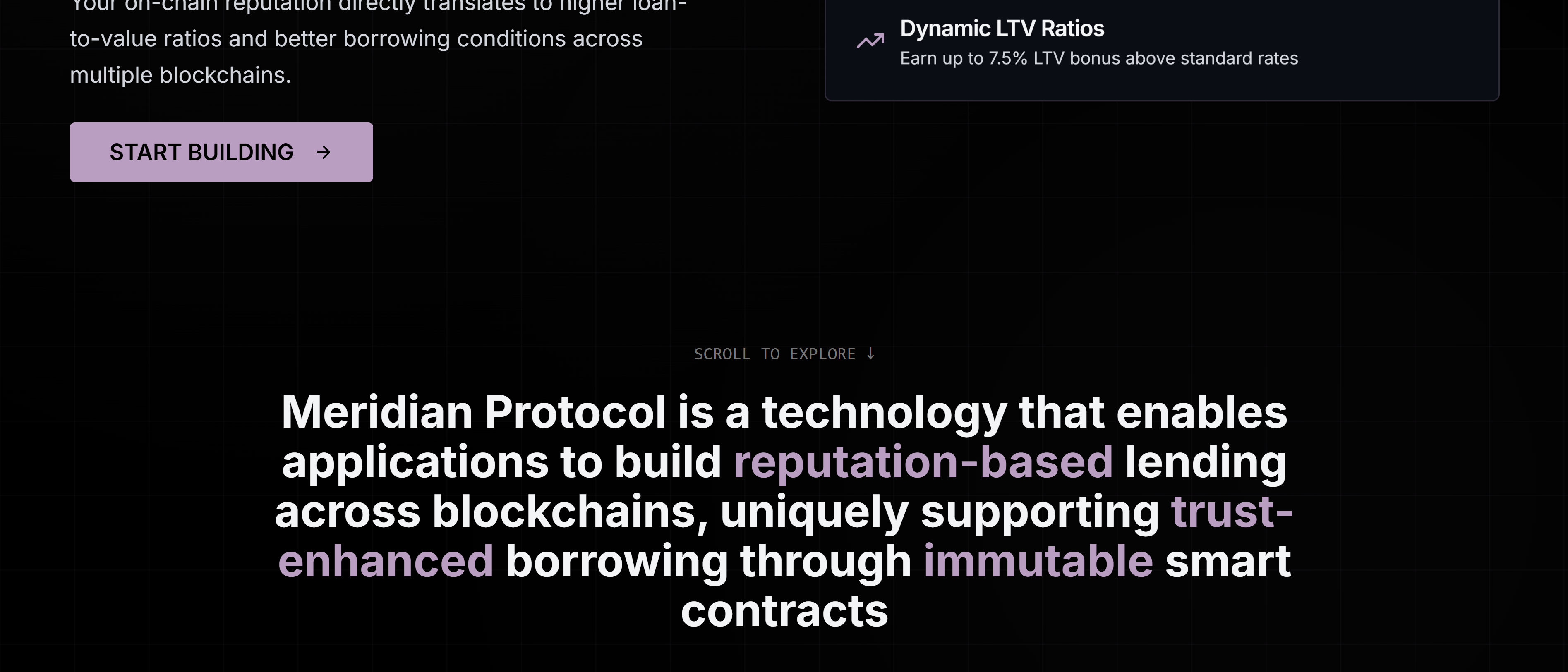
Meridian Protocol landing page statement describing reputation-based lending across blockchains through immutable smart contracts
Protocol positioning: reputation-based lending across chains.

06

Architecture

Meridian Protocol flow
System flow
  1. 01IdentityEthereum · reputation state
  2. 02Reputation engineTrust score · term mapping
  3. 03LayerZeroCross-chain messaging
  4. 04Lending executionSolana · collateral · positions
  5. 05ApplicationDeposits · borrowing · terms
Reputation is derived against Ethereum history; LayerZero carries state to Solana where positions execute; the application exposes both as terms a borrower can read.

07

Implementation

Reputation is anchored on Ethereum so the history that determines terms sits on the chain with the deepest settlement record, while the borrowing itself runs on Solana where cost and latency matter to the borrower.

LayerZero is used as the messaging layer, carrying position and reputation updates between chains rather than routing funds through a single custodial bridge.

The trust score maps on-chain behaviour onto loan parameters — eligible amount and LTV — rather than producing an opaque number. The interface surfaces it as concrete terms.

The frontend is the protocol's public surface: deposits from Ethereum to Solana, position state, and the terms a given trust score unlocks.

08 / Hard parts

The hard engineering.

Reputation that has to survive a chain boundary

A score computed on Ethereum is only useful if Solana can act on it. Making that handoff explicit — what is authoritative, what is derived, what is true while a message is still in flight — was the central design problem.

Pricing trust when history can be manufactured

On-chain history is observable but gameable: a wallet can be built to look trustworthy cheaply. The model had to weight behaviour that is expensive to fake and stay conservative where the signal is thin.

Two chains, one position

Deposits start on Ethereum and positions live on Solana. Keeping a single coherent position across two execution environments with asynchronous messaging between them is where most of the correctness work sits.

Making terms legible

Better rates only matter if the borrower can see why they qualified. Surfacing the trust score as readable terms — eligible amount, LTV, bonus — was treated as a product requirement, not a dashboard detail.

09

Results

A working prototype: reputation derived from on-chain behaviour, cross-chain messaging between Ethereum and Solana through LayerZero, and loan terms that improve with trust score. The interface states up to a 7.5% LTV bonus above standard rates for the strongest scores — a stated protocol maximum, not a measured portfolio outcome. This is a prototype under development: no audit, no live deposits and no production figures are claimed.

7.5%
Max LTV bonus above standard

Stated in the protocol interface

2
Chains

Ethereum identity · Solana execution

LayerZero
Cross-chain messaging

State between chains

10

Proof & technology

Evidence

  • Demo

    Protocol interface screenshots

  • Case study

    Architecture and term model

  • Private

    Contracts and deployments held internally

Technology

EthereumSolanaLayerZeroSmart contractsCross-chain messagingDeFi lending

Start a project

Building something difficult?

If this kind of system is close to your problem, tell us what you are trying to ship.